
You might hear friends or family saying “gross” when they see flakes on your shoulders. Or someone makes a joke. This makes me self-conscious and always sets me back a little (even knowing what I know now about what actually causes this thing). Because here’s the truth: dandruff has almost nothing to do with how clean you are.
That’s the biggest misconception out there. The one that quietly makes people feel ashamed when they shouldn’t.
I want to lay out exactly why that’s wrong, because once you understand the actual cause, a lot of other common beliefs fall apart too.
Dandruff is a Skin Condition, Not a Cleanliness Problem
Dandruff (or in its more pronounced form, [seborrheic dermatitis](what-is-dandruff/)) is driven by a combination of three things: a yeast called Malassezia that lives on everyone’s scalp, your scalp’s natural oil (sebum), and your individual skin’s sensitivity. That last part is key. Two people can have the exact same amount of yeast and oil on their scalps and one will have no issues at all while the other deals with flaking every day. The difference isn’t hygiene. It’s biology.
Here’s the actual chain of events, as best we understand it: Malassezia feeds on sebum. It secretes enzymes called lipases that break the oil down into fatty acids. One of those byproducts is oleic acid. In people with a more sensitive or compromised skin barrier, that oleic acid penetrates the outer layer of skin and triggers irritation, inflammation, and the rapid cell turnover we recognize as flaking. Research published in PMC describes this mechanism in detail: it’s the lipase activity, not dirt, that’s doing the damage.
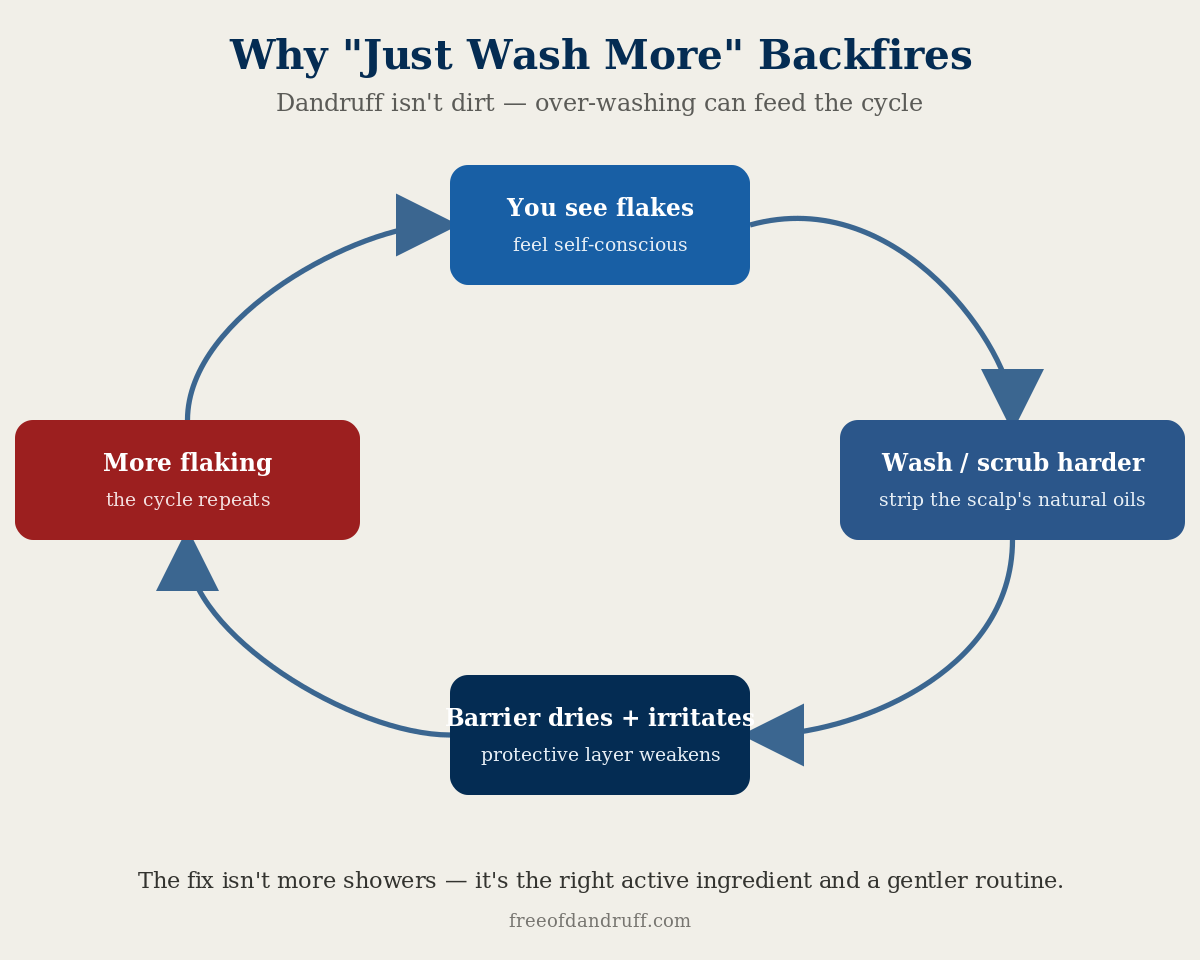
So if you’ve been scrubbing harder and shampooing more often hoping to clear things up, I’m sorry to be the one to tell you: that’s probably not helping. It might be making things worse.
Why More Washing Can Actually Backfire
This surprised me when I first read it. The instinct makes sense: if there’s something on your scalp causing a problem, wash it off, right? But your scalp has a protective skin barrier. When that barrier is already compromised (which, in people prone to dandruff, it often is), aggressive washing strips away the natural lipids that hold it together. You’re left with a scalp that’s more irritated, more exposed, and more reactive.
A 2023 study published in Experimental Dermatology found that seborrheic dermatitis patients specifically show measurable skin barrier dysfunction and altered ceramide composition in the stratum corneum: the outer skin layer. Ceramides are basically the mortar between your skin cells. Less of them means a weaker wall. Harsh washing accelerates that breakdown.
The science consistently points to [Malassezia](malassezia-globosa-explained/) and barrier function (not how often you shower) as the real drivers here. [See more on the three-factor cause model here.](/3-common-causes-of-dandruff/)
Other Myths Worth Clearing Up
“It’s dry scalp.” Not necessarily. This is a common mix-up, but [dandruff and dry scalp](dandruff-vs-dry-scalp/) are different things. Dry scalp flakes tend to be smaller and whiter; dandruff flakes are often larger, oilier, and yellowish. Dry scalp is about lack of moisture. Dandruff is about Malassezia activity and barrier sensitivity. The treatments are different too: moisturizing a dandruff scalp won’t fix it the way an antifungal shampoo will.
“Washing my hair more will cure it.” I already covered this above, but it bears repeating: frequency of washing isn’t the fix. The fix is addressing the fungal activity with the right active ingredient: things like ketoconazole, selenium sulfide, or zinc pyrithione (though zinc pyrithione was actually banned in EU cosmetics as of 2022 after being reclassified as a potential carcinogen; worth knowing if you’re in Europe). Washing alone doesn’t touch Malassezia.
“It’s contagious.” This one I hear less often, but it does come up. It’s not. Malassezia is already present on virtually every human scalp; it’s part of the normal skin microbiome. You can’t “catch” dandruff from sharing a hat or a pillow. What you’re sensitive to is your own scalp’s reaction to the fungus, and that’s something you’re largely born with, not something you pick up from someone else. Mayo Clinic is clear on this: dandruff is not contagious.
“Only people with oily hair get it.” Also not true. Sebum is required for Malassezia to thrive, so oil does play a role; but people with drier scalps can still get dandruff, especially if their skin barrier is particularly sensitive. And seborrheic dermatitis can show up in other areas entirely: eyebrows, the sides of the nose, behind the ears. Not exactly a “you washed your hair too little” kind of pattern.
The Real Takeaway
The shame around dandruff is built on a false premise. It’s not that you’re dirty. It’s not that you’re careless. You have a yeast living on your scalp (like everyone else does) and your skin is reacting to what that yeast leaves behind. That’s a biological reality, not a character flaw.
What actually helps is understanding that mechanism and working with it. Finding the right antifungal active ingredient, being consistent with it, and not over-stripping your scalp in the process. I’ve been down the road of scrubbing harder and switching shampoos constantly; it didn’t help until I understood what was actually going on.
If you want to go deeper on the science behind why dandruff happens, start with [what dandruff actually is](/what-is-dandruff/) and then look at [the three main causes](/3-common-causes-of-dandruff/). That’ll give you a solid foundation before you start looking at treatment options.
About the author: I’m Dusty Combs. I’ve dealt with dandruff and seborrheic dermatitis for years, and this site is where I document what I learn: what the research says, what works, what doesn’t. I’m not a doctor or a dermatologist. This is one person’s honest look at a condition I live with.
Last updated: June 2026
This article is for informational purposes only and is not a substitute for professional medical advice, diagnosis, or treatment.
References
- Ro BI, Dawson TL. “The role of sebaceous gland activity and scalp microfloral metabolism in the etiology of seborrheic dermatitis and dandruff.” Journal of Investigative Dermatology Symposium Proceedings. 2005. https://www.jidsponline.org/article/S0022-202X(15)52658-4/fulltext52658-4/fulltext)
- Ianiri G, et al. “Skin Commensal Fungus Malassezia and Its Lipases.” PMC9705927. 2022. https://pmc.ncbi.nlm.nih.gov/articles/PMC9705927/
- Rousel J, et al. “Lesional skin of seborrheic dermatitis patients is characterized by skin barrier dysfunction and correlating alterations in the stratum corneum ceramide composition.” Experimental Dermatology. 2024. https://pubmed.ncbi.nlm.nih.gov/37974545/
- Mayo Clinic. “Dandruff: Symptoms and Causes.” https://www.mayoclinic.org/diseases-conditions/dandruff/symptoms-causes/syc-20353850
- Borda LJ, Wikramanayake TC. “Seborrheic Dermatitis and Dandruff: A Comprehensive Review.” PMC4852869. 2015. https://pmc.ncbi.nlm.nih.gov/articles/PMC4852869/