
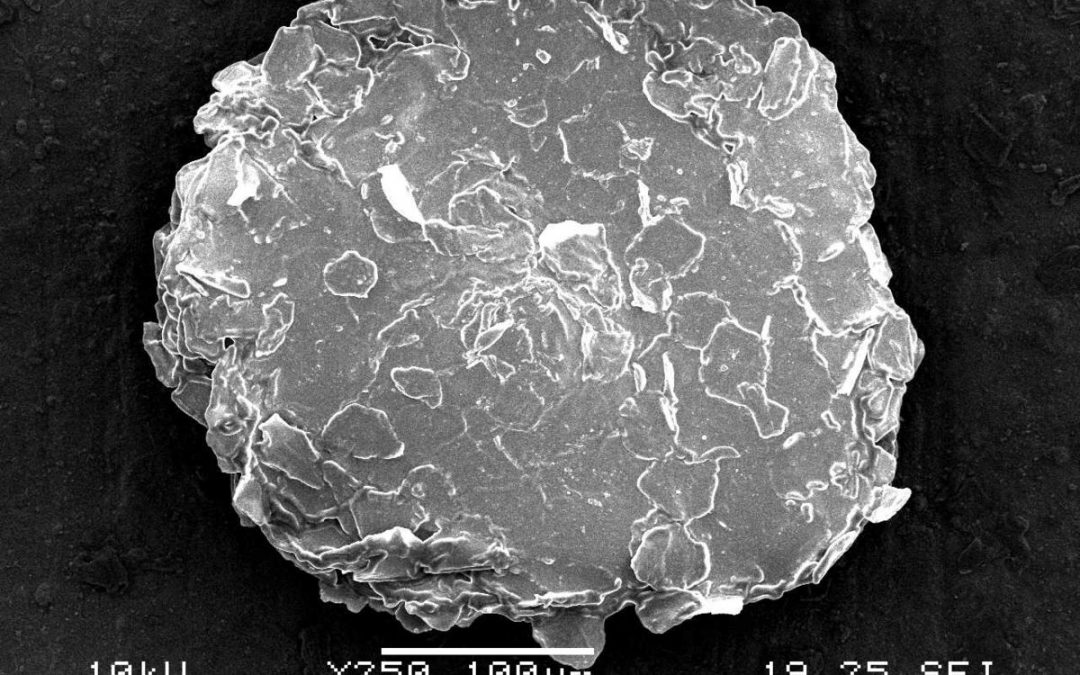
I used to think dandruff was pretty simple: oily scalp, dry winter air, maybe not shampooing enough. That was wrong. The more I dug into this, the more I realized dandruff is the result of several things happening at once, and that’s exactly why it’s so frustrating to deal with. Fix one piece and you still have the problem.
Here’s what the research actually shows.
The old explanation (and why it’s incomplete)
For a long time, dandruff was framed as either an oil problem or a hygiene problem. Oily scalp → sticky skin cells → clumping → flakes. Simple enough. And hygiene? The idea that you just weren’t washing your hair properly is still floating around out there.
Neither explanation holds up. The #1 Misconception About Dandruff
Plenty of people with oily scalps never get dandruff. Plenty of people who wash their hair daily still suffer. The hygiene framing in particular was always a bit of a myth; and over-washing can actually make things worse, because it strips the barrier your scalp needs.
The current science points to a multi-factor model. It’s not one thing. It’s the interaction of several things.
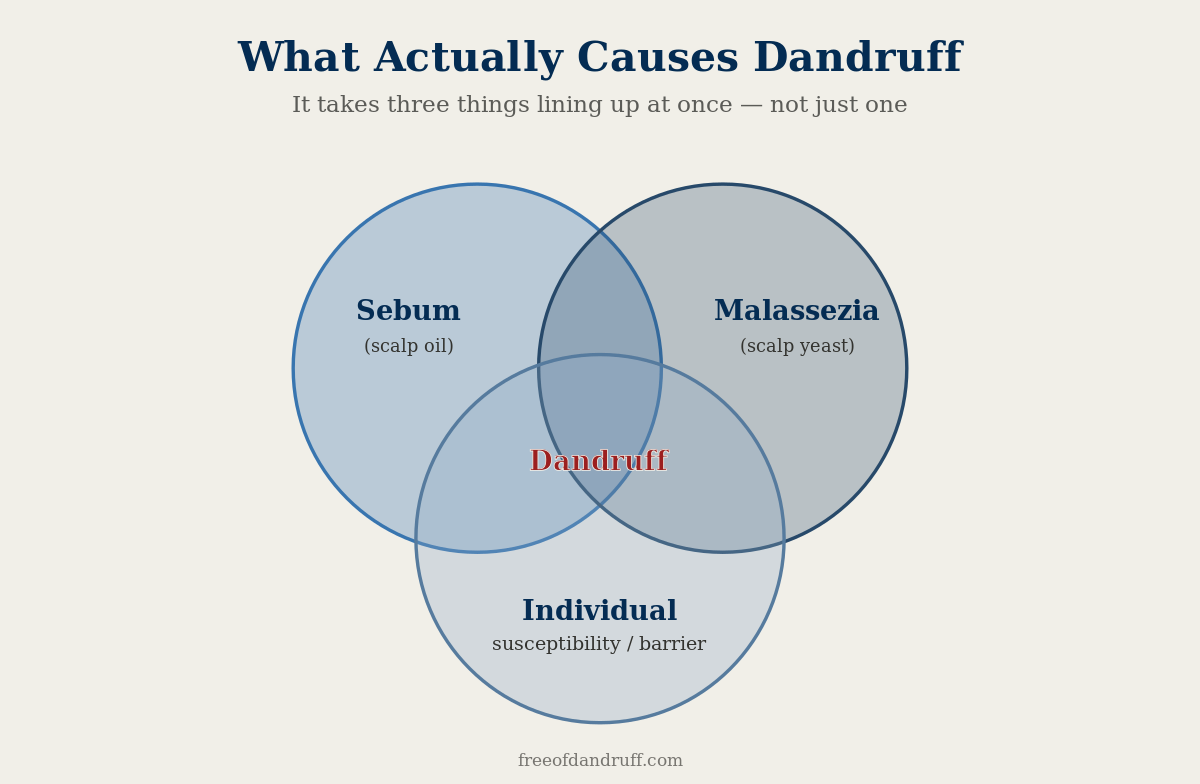
Factor 1: Sebum (your scalp’s oil)
Your scalp produces sebum, a natural oil that keeps skin from drying out. That’s not the problem. Sebum is there for a reason.
The issue is that sebum is also food: specifically for a yeast that lives on almost every human scalp. What Is Dandruff?
For people who are prone to dandruff, the scalp’s oil output matters because it directly feeds what comes next.
Factor 2: Malassezia (the fungus that’s probably the main driver)
This is the part that honestly surprised me when I first read it.
There’s a yeast called Malassezia that lives on virtually everyone’s scalp. It’s been there your whole life. You can’t wash it off and you can’t permanently eliminate it; it’s a permanent resident. For most people, it causes no problems at all. For some people, it sets off a chain reaction that ends in dandruff.
For years, the science pointed at a species called Malassezia furfur. More recent whole-genome research has narrowed that down: M. globosa and M. restricta appear to be the main culprits on the human scalp. M. globosa in particular has very high lipase activity, meaning it produces enzymes that break down oils.
Here’s what happens. Malassezia secretes lipases: enzymes that chop up the triglycerides in your sebum. The yeast consumes the saturated fatty acids it needs. What it leaves behind are the unsaturated ones, especially oleic acid.
In people with a compromised skin barrier (more on that below), oleic acid penetrates the scalp. The immune system responds. Skin cells turn over faster than normal. That rapid turnover is what you see as flakes.
What’s important here: the yeast is present on most people’s scalps. The oleic acid gets produced on most people’s scalps. The difference is what happens after that (and that’s where factors three and four come in).
Factor 3: Skin-barrier dysfunction
This is the piece I see missing from most dandruff explainers.
Research on seborrheic dermatitis (the clinical, inflammatory version of dandruff) consistently shows that affected scalps have a compromised skin barrier: specifically, lower levels of ceramides, disrupted intercellular lipids, and elevated transepidermal water loss. The barrier isn’t doing its job of keeping irritants out.
When oleic acid lands on a normal, intact barrier, it mostly stays on the surface and gets washed away. When it lands on a weakened barrier, it gets in. That’s when the inflammatory response kicks off.
This is also part of why over-washing is counterproductive for some people. Strip the barrier repeatedly and you make the underlying problem worse, not better.
The ceramide research (published in Experimental Dermatology in 2024) found that lesional skin in seborrheic dermatitis patients showed significant ceramide depletion compared to unaffected skin. Barrier restoration is now being looked at as a legit therapeutic target: not just the antifungals.
Factor 4: Individual immune sensitivity
Two people can have the same yeast levels, the same sebum output, and the same compromised barrier (and one has dandruff while the other doesn’t). That fourth factor is individual immune response.
Some people’s immune systems react more strongly to oleic acid and to Malassezia metabolites in general. The reaction triggers faster keratinocyte (skin cell) turnover, inflammation, and the visible flaking and itch. Others have what appears to be a more tolerant response.
There’s also a genetic dimension here. Family history does seem to play a role in who develops seborrheic dermatitis: not in a simple “one gene causes this” way, but in terms of baseline barrier function and immune tendencies.
Secondary contributors: what the evidence actually says
These come up constantly in dandruff discussions, so let me be honest about what the evidence does and doesn’t show.
Stress. This one has real support. Multiple studies link psychological stress to seborrheic dermatitis flares. A 2025 cohort study of 51 SD patients found a statistically significant correlation between perceived stress levels and symptom severity. The proposed mechanism: cortisol suppresses immune regulation and disrupts the skin barrier. Stress probably doesn’t cause dandruff from scratch; but if you’re already prone, a stressful period can absolutely set it off or make it worse.
Winter / cold weather. Also well-supported anecdotally and makes biological sense. Cold, dry air strips moisture from the barrier; indoor heating makes it worse; lower UV exposure removes a mild natural antifungal effect from sunlight. I notice this myself every year.
Diet. This one is trickier. People ask about sugar constantly. Honest answer: there’s no strong direct clinical evidence that sugar causes or dramatically worsens dandruff in otherwise healthy people. The theory is that high sugar feeds yeast systemically, but Malassezia lives on skin lipids, not dietary sugar; it’s not the same as oral Candida. That said, overall inflammatory diet patterns may affect skin barrier health generally. I wouldn’t tell you sugar is definitely the problem, but eating poorly probably doesn’t help.
Infrequent washing. Letting sebum pile up on the scalp does give Malassezia more to work with. But the flip side is that over-washing strips the barrier. Neither extreme is ideal. Finding your frequency is part of the puzzle.
How common is dandruff, actually?
The old stat you’ll see around the internet (including on this site until now) is that “half the population of the world” has dandruff. I need to correct that, because it’s too imprecise.
The full spectrum looks like this: mild flaking at some point in life is extremely common. Most people deal with some degree of scalp flaking, especially seasonally.
But clinically diagnosed seborrheic dermatitis (the persistent, inflammatory version) is much less common. A 2024 meta-analysis in JAMA Dermatology pooled data from 121 studies and 1.26 million people across 9 countries. The global prevalence of diagnosed SD came out to 4.38%. In adults specifically, it’s 5.64%. Rates varied: South Africa came in highest at 8.82%, India lowest at 2.62%, and the US at 5.86%.
So “half the world has dandruff” overstates the clinical condition significantly. A more accurate framing: scalp flaking is very common; persistent, diagnosed seborrheic dermatitis affects roughly 1 in 20 people globally.
The bottom line
Dandruff isn’t a hygiene failure or just oily skin. It’s the product of Malassezia yeast breaking down sebum, leaving oleic acid behind, that acid penetrating a compromised skin barrier, and your immune system reacting to it. All four factors (fungus, oil, barrier, immunity) have to line up in a certain way. That’s why the same scalp conditions produce dandruff in one person and nothing in another.
It’s also why treatment works better when you understand the mechanism. Targeting the fungus is step one for most people, but barrier support matters too. I go deeper on treatments in separate posts, but understanding this model is the starting point.
About Dusty Combs: I’m the founder of freeofdandruff.com. I’ve had dandruff and seborrheic dermatitis for years. I’m not a doctor or dermatologist; I’m a regular person who got frustrated enough to actually read the research. Everything here is what I’ve learned; always check with a dermatologist for your specific situation.
Last updated: June 2026
This article is for informational purposes only and does not constitute medical advice. Consult a qualified healthcare provider for diagnosis and treatment.
References
- Ro BI, Dawson TL. “Three Etiologic Facets of Dandruff and Seborrheic Dermatitis: Malassezia Fungi, Sebaceous Lipids, and Individual Sensitivity.” Journal of Investigative Dermatology Symposium Proceedings, 2005. https://www.sciencedirect.com/science/article/pii/S0022202X15526146
- DeAngelis YM et al. “Malassezia globosa and restricta: Breakthrough Understanding of the Etiology and Treatment of Dandruff and Seborrheic Dermatitis through Whole-Genome Analysis.” Journal of Investigative Dermatology Symposium Proceedings, 2007. https://www.jidsponline.org/article/S0022-202X(15)52658-4/fulltext
- Wu G et al. “Skin Commensal Fungus Malassezia and Its Lipases.” PMC, 2022. https://pmc.ncbi.nlm.nih.gov/articles/PMC9705927/
- Rousel J et al. “Lesional skin of seborrheic dermatitis patients is characterized by skin barrier dysfunction and correlating alterations in the stratum corneum ceramide composition.” Experimental Dermatology, 2024. https://pubmed.ncbi.nlm.nih.gov/37974545/
- Mawardi P et al. “The Global Prevalence of Seborrheic Dermatitis: A Systematic Review and Meta-Analysis.” JAMA Dermatology, 2024. https://jamanetwork.com/journals/jamadermatology/fullarticle/2820685
- Mayo Clinic. “Seborrheic dermatitis: Symptoms and causes.” https://www.mayoclinic.org/diseases-conditions/seborrheic-dermatitis/symptoms-causes/syc-20352710