
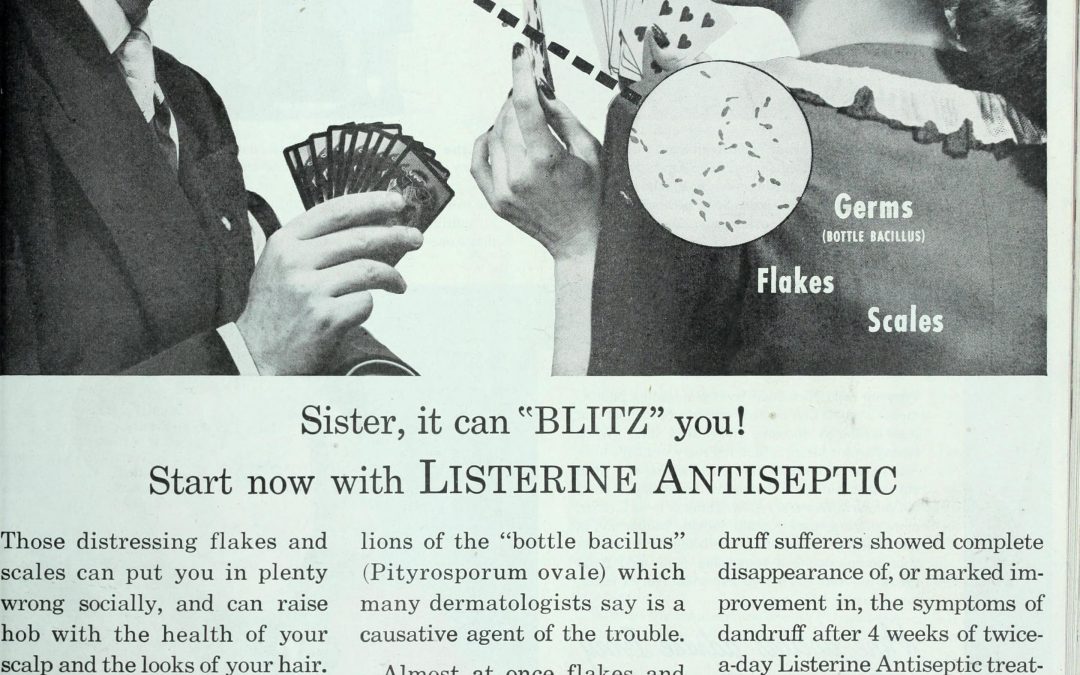
I remember the first time I really looked at my shoulders after putting on a dark shirt and thought: okay, this is an actual problem. White flakes, visible to anyone standing near me. Not a great feeling. I started reading everything I could find, and a lot of what I found was wrong, or at least outdated.
So let’s fix that. Today I want to give you a real answer to the most basic question: what actually is dandruff?
Because the answer I kept finding (“it’s your scalp producing too much oil”) turns out to be only part of the picture.
The Old Answer (and Why It’s Incomplete)
For a long time, the standard explanation went something like this: your sebaceous glands get overactive, pump out too much sebum (that’s scalp oil), and the excess makes dead skin cells clump together and fall off as flakes.
That’s not wrong exactly. Sebum does play a role. But framing dandruff as a pure oil problem leaves out what’s actually doing most of the damage; and that matters, because it changes what you should do about it.
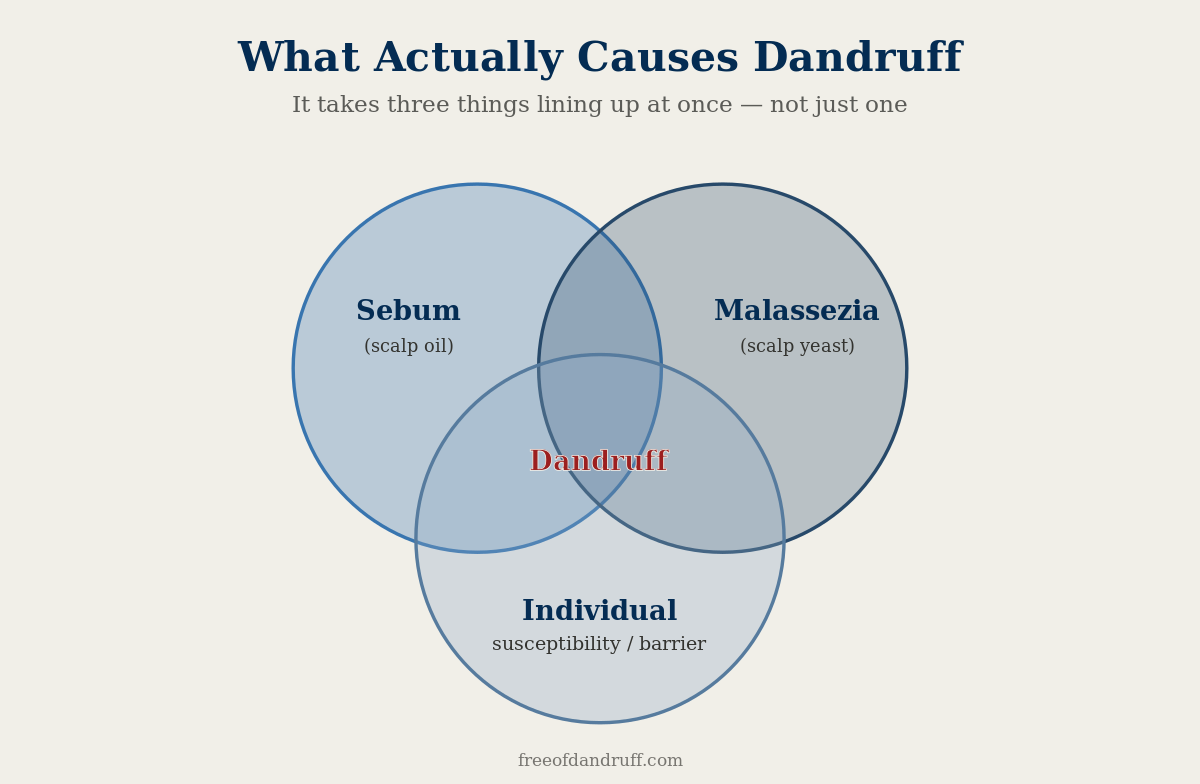
The more complete picture looks like this: dandruff appears to result from the interaction of three things: your scalp’s oil production, a specific type of fungus that lives on your head, and your individual immune response to what that fungus does. All three have to line up in an unfortunate way. That’s why two people can have identical oily scalps and one gets dandruff and the other doesn’t.
The Fungus You Already Have
Here’s something that genuinely surprised me when I first read it: every human scalp hosts a fungus called Malassezia. It’s not a sign of poor hygiene. It lives there whether you wash your hair daily or once a week. It’s just part of the normal scalp microbiome.
What researchers figured out (particularly after whole-genome sequencing work published in the Journal of Investigative Dermatology) is that the species doing most of the work in dandruff aren’t just generic Malassezia. The two that matter most are Malassezia globosa and Malassezia restricta. Earlier science pointed the finger at a different species (M. furfur), but those two are the main actors on dandruff-prone scalps. M. globosa shows the highest lipase activity of the bunch; M. restricta shows up in higher concentrations on flaky scalps than on healthy ones.
Lipase activity is the key phrase there. Let me explain what that actually means.
What the Fungus Actually Does to Your Scalp
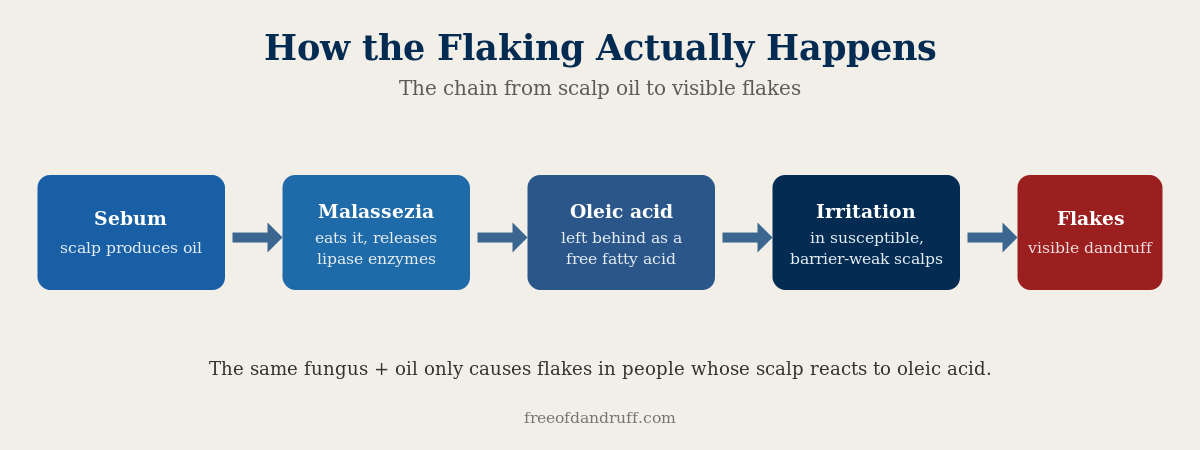
Malassezia is what’s called an obligate lipophile: it needs fat to survive. It can’t make its own, so it feeds on yours. Specifically, it secretes enzymes called lipases that break down the triglycerides in your sebum into free fatty acids. Then it absorbs the saturated fatty acids it needs and leaves the rest behind.
What it leaves behind is where the problem starts. The fatty acid left in the highest quantity is oleic acid; and for people with sensitive or barrier-compromised scalps, oleic acid is an irritant. It penetrates the outer skin layer, disrupts the normal process by which dead skin cells shed, and triggers accelerated cell turnover and inflammation. The result is visible flaking.
A 2022 review in Frontiers in Microbiology (PMC9705927) covers how Malassezia lipases degrade sebum into oleic acid and arachidonic acid, both of which act as irritants with desquamative effects on skin cells. Researchers have actually demonstrated experimentally that applying oleic acid alone to scalps can initiate dandruff-like flaking in susceptible individuals. The fungus is the trigger; oleic acid is the mechanism.
So the chain looks like this: sebum → Malassezia secretes lipases → lipases free oleic acid → oleic acid irritates susceptible scalp → flaking.
The “too much oil” theory skips the middle entirely.
Why It Only Affects Some People
This is the part that took me a while to understand. If everyone has Malassezia, and everyone produces sebum, why do some people get dandruff and others don’t?
The answer comes down to individual susceptibility: specifically, whether your skin barrier is functioning properly.
Think of the outer layer of your scalp as a wall. In people with healthy barriers, it keeps moisture in and irritants out. In people predisposed to dandruff, that wall has gaps. The scientific framing involves increased transepidermal water loss (TEWL) and reduced epidermal lipid production; but the plain-English version is: the barrier is leaky, oleic acid gets in more easily, the immune system overreacts, and the skin starts turning over faster than it should.
That immune overreaction is why dandruff-prone scalps often itch and look inflamed, not just flaky. Your skin isn’t merely shedding; it’s reacting. And scratching (I know, it’s hard to stop) causes more barrier damage, which restarts the whole cycle.
A comprehensive PMC review of seborrheic dermatitis (PMC4852869) lays out how skin barrier dysfunction (disrupted lipid organization, compromised desquamation) creates the environment where Malassezia activity tips over into symptoms. The immune response then damages the barrier further. It loops.
Dandruff vs. Seborrheic Dermatitis: Are They the Same Thing?
You’ve probably seen the term seborrheic dermatitis (sometimes shortened to “seb derm”) and wondered if that’s a different condition from dandruff. Short answer: they’re on the same spectrum.
Mild dandruff (white or yellowish flakes, maybe some scalp itch, no redness) is the common, non-inflammatory end of that spectrum. Seborrheic dermatitis is the clinical, inflammatory version: more visible redness, greasier or yellowish scales, and often affecting areas beyond the scalp: the sides of the nose, eyebrows, ears, and sometimes the chest.
dandruff or dry scalp: how to tell the difference
How common is each? This is worth getting right, because a lot of sites throw around wild numbers without sourcing them.
A 2024 systematic review in JAMA Dermatology (PMC11223058) (the most rigorous global estimate I’ve seen) analyzed 121 studies covering over 1.26 million people across 9 countries. It found a global pooled prevalence of clinically diagnosed seborrheic dermatitis of 4.38%. Adults run a bit higher (~5.64%); children lower (~3.70%). In absolute numbers, that’s roughly 135 million people globally as of 2021, a figure that’s been rising.
Mild dandruff without full clinical SD is far more common than that. Most people experience some flaking at some point. But the claim you’ll see everywhere (“half the world’s population has dandruff”) doesn’t have a clean citation behind it. The hard number is 4.38% for diagnosed SD. Where you fall on the spectrum shapes what you should do.
is dandruff actually a disease?
Where Dandruff Happens
Most people think of dandruff as a scalp-only problem. It’s most visible there, but it follows sebaceous glands: wherever those glands are dense, Malassezia has a food source.
That means dandruff can show up on:
- The scalp (most common, and where people notice it first)
- Eyebrows: often overlooked, more common than you’d think
- Sides of the nose and nasolabial folds
- Behind and inside the ears
- The beard and mustache area
- Upper chest: less common but documented
Beard dandruff comes up a lot. Facial hair creates its own microclimate: warmth, moisture, and sebum from the skin underneath: ideal conditions for Malassezia. If you’re seeing flakes in or under your beard, it’s the same underlying process, just a different location. The same antifungal actives that work on your scalp apply here.
What This Means for Treatment
If dandruff were purely an oil problem, drying out your scalp with harsh cleansers would make sense. It doesn’t work that way (and now you can see why). Stripping oil doesn’t interrupt the Malassezia activity, and in many cases aggressive washing damages the barrier, which makes the cycle worse.
the biggest misconception about treating dandruff
What actually works targets the fungus directly: antifungal shampoo actives like ketoconazole, zinc pyrithione, selenium sulfide, and piroctone olamine. That gets into more detail in the causes and treatment posts.
the three factors that actually cause dandruff
a closer look at Malassezia globosa
For now, the main thing to take away is this: dandruff isn’t a hygiene failure or a simple oil problem. It’s a multi-factor condition involving a fungus you already have, sebum it feeds on, a chemical byproduct that irritates susceptible scalps, and an immune response that gets the flaking started. Understanding that is actually kind of a relief: because it means the solution is specific, not just “wash more.”
About the Author
Dusty Combs is the founder of freeofdandruff.com. He’s not a doctor or dermatologist; he’s someone who has dealt with dandruff and seborrheic dermatitis for years and got tired of generic advice. This site documents what he reads, what he tries, and what he learns. If something worked or didn’t, he says so.
Last updated: June 2026
This article is for informational purposes only and does not constitute medical advice. Consult a qualified healthcare provider about any skin condition.
References
- DeAngelis YM et al. “Malassezia globosa and restricta: Breakthrough Understanding of the Etiology and Treatment of Dandruff and Seborrheic Dermatitis through Whole-Genome Analysis.” J Investig Dermatol Symp Proc. 2005. https://www.jidsponline.org/article/S0022-202X(15)52658-4/fulltext
- Wu G et al. “Skin Commensal Fungus Malassezia and Its Lipases.” Front Microbiol. 2022. PMC9705927. https://pmc.ncbi.nlm.nih.gov/articles/PMC9705927/
- Borda LJ, Wikramanayake TC. “Seborrheic Dermatitis and Dandruff: A Comprehensive Review.” J Clin Investig Dermatol. 2015. PMC4852869. https://pmc.ncbi.nlm.nih.gov/articles/PMC4852869/
- Chovatiya R et al. “The Global Prevalence of Seborrheic Dermatitis: A Systematic Review and Meta-Analysis.” JAMA Dermatol. 2024;160(9). PMC11223058. https://pmc.ncbi.nlm.nih.gov/articles/PMC11223058/ | https://jamanetwork.com/journals/jamadermatology/fullarticle/2820685
- Schwartz JR et al. “Stratum corneum dysfunction in dandruff.” Int J Cosmet Sci. 2013. PMC3494381. https://pmc.ncbi.nlm.nih.gov/articles/PMC3494381/
Great post. Do you have any other ones you can give? I adore the content. 🙂