
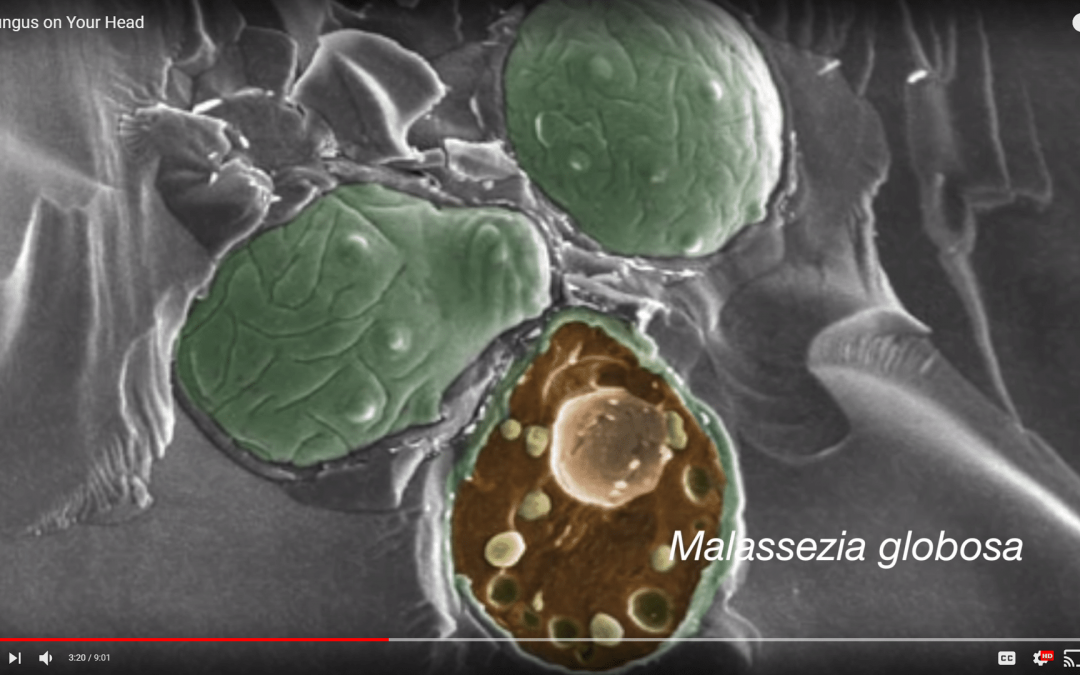
A while back I watched a Veritasium video about the yeast living on nearly every human scalp (the same yeast that causes dandruff) and I promised I’d go do the reading and come back with the real detail. Well, here it is.
Fair warning: this one gets into the science. But stick with me, because understanding what is actually happening on your scalp is honestly the most useful thing I’ve found on this whole journey. Once you get it, you stop blaming yourself and you stop buying random shampoos that don’t address the actual problem.
Meet Malassezia: the fungus that lives on almost everyone
The organism behind dandruff is a yeast called Malassezia. It lives on scalps, faces, and other oily patches of skin on the vast majority of humans. You almost certainly have it right now. So does your dermatologist. So does everybody reading this over your shoulder on the subway.
That last part is important: having Malassezia on your scalp does not automatically mean you have dandruff. Most people carry it without any visible symptoms at all. Why it causes problems for some people and not others is exactly what makes dandruff so interesting (and so frustrating).
There are about 18 known Malassezia species. For a long time, scientists focused on one called M. furfur as the main troublemaker. But as molecular biology tools got more precise in the 1990s and 2000s, researchers could finally tell the species apart genetically (and it turned out the early attribution was wrong). The species actually doing the damage on dandruff scalps are M. globosa and M. restricta. what causes dandruff
This matters more than it sounds. The whole-genome sequencing work on M. globosa and M. restricta (published in the Journal of Investigative Dermatology) gave scientists an unprecedented look at how these organisms are built (and what they’re doing up there on your head).
What Malassezia actually does (and why it’s kind of fascinating)
Here’s the thing about Malassezia that I find genuinely surprising: it can’t make its own fat.
Most organisms synthesize their own fatty acids. Malassezia can’t: it’s missing the gene for fatty acid synthase. Which means it has to get its fat from somewhere else. And it’s sitting on a scalp that produces sebum, which is basically a rich cocktail of lipids. So Malassezia evolved to live off that.
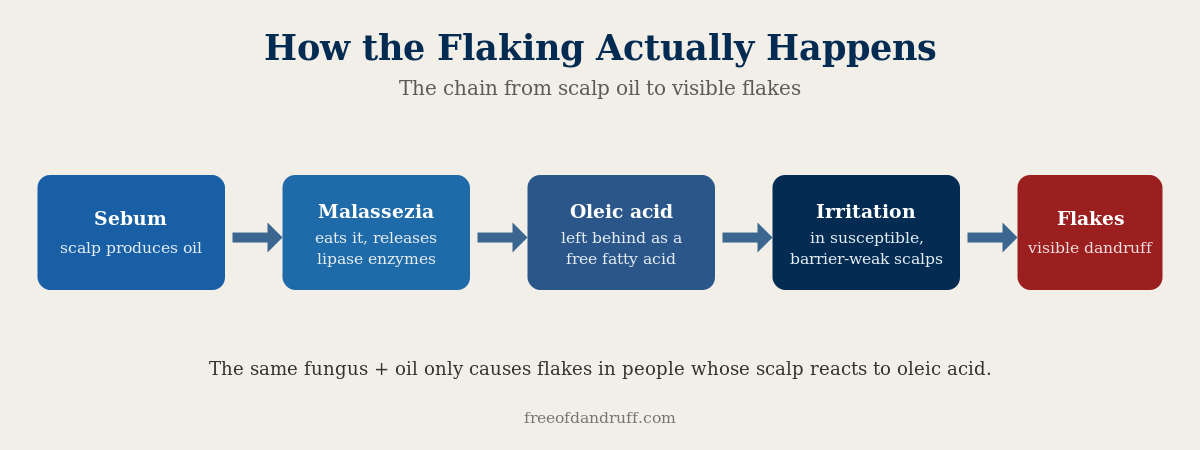
The mechanism works like this:
- Your sebaceous glands produce sebum: the natural oil of your scalp. Sebum contains triglycerides (fat molecules with three fatty acid chains attached).
- Malassezia secretes lipase enzymes that break those triglycerides apart, freeing the fatty acids.
- The yeast then absorbs the saturated fatty acids it needs to survive and reproduce.
- What it doesn’t use (what it leaves behind) includes oleic acid, an unsaturated fatty acid.
That oleic acid is where the trouble starts.
Research published in the JID found that oleic acid is a genuine skin irritant on susceptible scalps. In studies, applying oleic acid directly to the scalp of people without dandruff caused no visible reaction. But in people who are prone to dandruff, it caused dandruff-like flaking. The same substance, totally different response. That’s your first clue that the fungus alone isn’t the whole story. why dandruff happens
The three-factor model: why you have dandruff and your friend doesn’t
Current science describes dandruff (and its more inflamed cousin, seborrheic dermatitis) as the result of three things converging at once:
1. Malassezia on the scalp: specifically M. globosa and M. restricta doing their lipase work and leaving oleic acid behind.
2. Sebum: the fuel source. Without enough scalp oil, Malassezia can’t thrive. That’s why dandruff tends to be worse in sebum-heavy areas (the crown, behind the ears, sometimes the face) and why it often worsens around puberty when oil production ramps up.
3. Individual susceptibility: this is the one that explains everything your shampoo commercials never mention. People who get dandruff appear to have a skin-barrier dysfunction in the scalp. Their stratum corneum (the outermost layer of skin) has a compromised lipid structure that lets irritants like oleic acid penetrate more easily. is dandruff a disease Meanwhile, someone with a healthy, intact barrier can have the same fungal load and the same sebum production and feel nothing.
This three-factor framing comes from a symposium piece in the Journal of Investigative Dermatology and has become the accepted modern model. It replaced the older view that dandruff was basically an oil or hygiene problem (which, I’ll say it again, it is not). I covered that misconception in a separate post, but the mechanism here is why: hygiene doesn’t change your skin-barrier genetics or eliminate the fungus, so scrubbing harder doesn’t help and might actually make the barrier worse.
The scalp as an ecosystem
Something I didn’t appreciate until recently: your scalp isn’t just fungus. It’s a whole ecosystem. The scalp microbiome includes bacteria alongside Malassezia, and they’re in a constant push-and-pull.
Research comparing healthy scalps to dandruff-affected scalps found that dandruff scalps tend to show Malassezia levels about 1.5 to 2 times higher than on healthy scalps. They also show shifts in the bacterial community: more Staphylococcus bacteria, less Cutibacterium. Whether the bacterial shift causes the dandruff, results from it, or just travels alongside it is still being worked out. But it reinforces the idea that dandruff isn’t a single-organism problem with a single-organism solution.
scalp microbiome explained
What this means for treatment
So if M. globosa and M. restricta are the primary drivers, and their lipase activity is what produces the irritant oleic acid, then the logical target for treatment is the fungus itself. Which is exactly what the effective anti-dandruff actives do.
The main ones worth knowing:
- Ketoconazole: an antifungal that disrupts the fungal cell membrane. Available as 1% OTC or 2% prescription (Nizoral). One of the best-studied options for dandruff and seb derm.
- Zinc pyrithione (ZPT): the active in a lot of classic dandruff shampoos. Works by disrupting Malassezia metabolism by raising intracellular copper levels in the yeast. Note: as of March 2022, zinc pyrithione was banned in EU cosmetics, reclassified as a reproductive toxin. Still widely available in the US.
- Selenium sulfide: another antifungal active; head-to-head research shows it’s roughly on par with ketoconazole.
- Piroctone olamine: the one you’ll see more in European formulations. A study found it reduced dandruff by about 82% at six weeks, which is actually a strong result. Often paired with climbazole or salicylic acid.
ketoconazole vs zinc pyrithione
All of these work because they target the organism producing the oleic acid. Reduce Malassezia, reduce the lipase activity, reduce the irritant, reduce the flaking. That’s the chain. Understanding the chain is what makes picking a shampoo feel like something other than a guess.
One thing this model also explains: why dandruff often comes back. You didn’t cure yourself of susceptibility. You suppressed the fungal load. When you stop the active treatment, the population bounces back and the cycle restarts. That’s not a failure; that’s just the biology.
Where I landed on all this
I started reading about Malassezia because a video made me curious. I ended up reading through genome papers and JID symposium pieces and a dozen PMC abstracts, and what I came away with is mostly this: dandruff is a real biological condition with a real, well-understood mechanism. It’s not poor hygiene, it’s not bad luck, and it’s not something you should feel embarrassed about. Most of the planet is walking around with the same yeast on their heads. Some of us just drew the shorter straw on skin-barrier genetics.
The fungus is real, the mechanism is understood, and the treatments that work actually work for a reason. That’s a better place to start from than I had a few years ago.
About the author: I’m Dusty Combs; I’ve dealt with dandruff and seborrheic dermatitis for years and I write about what I learn along the way. I’m not a doctor or dermatologist. This site is me documenting the journey, not prescribing a treatment plan.
Last updated: June 2026
This article is for informational purposes only and is not a substitute for professional medical advice, diagnosis, or treatment.
References
- DeAngelis, Y.M. et al. Malassezia globosa and restricta: Breakthrough Understanding of the Etiology and Treatment of Dandruff and Seborrheic Dermatitis through Whole-Genome Analysis. Journal of Investigative Dermatology Symposium Proceedings. https://www.jidsponline.org/article/S0022-202X(15)52658-4/fulltext
- Ro, B.I. & Dawson, T.L. Three Etiologic Facets of Dandruff and Seborrheic Dermatitis: Malassezia Fungi, Sebaceous Lipids, and Individual Sensitivity. ScienceDirect / JID. https://www.sciencedirect.com/science/article/pii/S0022202X15526146
- Park, M. et al. Whole genome sequencing analysis of the cutaneous pathogenic yeast Malassezia restricta and identification of the major lipase expressed on the scalp of patients with dandruff. Mycoses, 2017. https://onlinelibrary.wiley.com/doi/10.1111/myc.12586
- Saxena, R. et al. Comparison of Healthy and Dandruff Scalp Microbiome Reveals the Role of Commensals in Scalp Health. PMC6180232. https://pmc.ncbi.nlm.nih.gov/articles/PMC6180232/
- Rousel, J. et al. Lesional skin of seborrheic dermatitis patients is characterized by skin barrier dysfunction and correlating alterations in the stratum corneum ceramide composition. Experimental Dermatology, 2024. https://onlinelibrary.wiley.com/doi/full/10.1111/exd.14952
- Wikramanayake, T.C. et al. Seborrheic dermatitis: Looking beyond Malassezia. Experimental Dermatology, 2019. https://onlinelibrary.wiley.com/doi/full/10.1111/exd.14006